HeriBase: AI Coin Identifier
- 4.7
- Rating
- 5.00M
- Installs
- Free
- Price

 Analysis by App-foxy
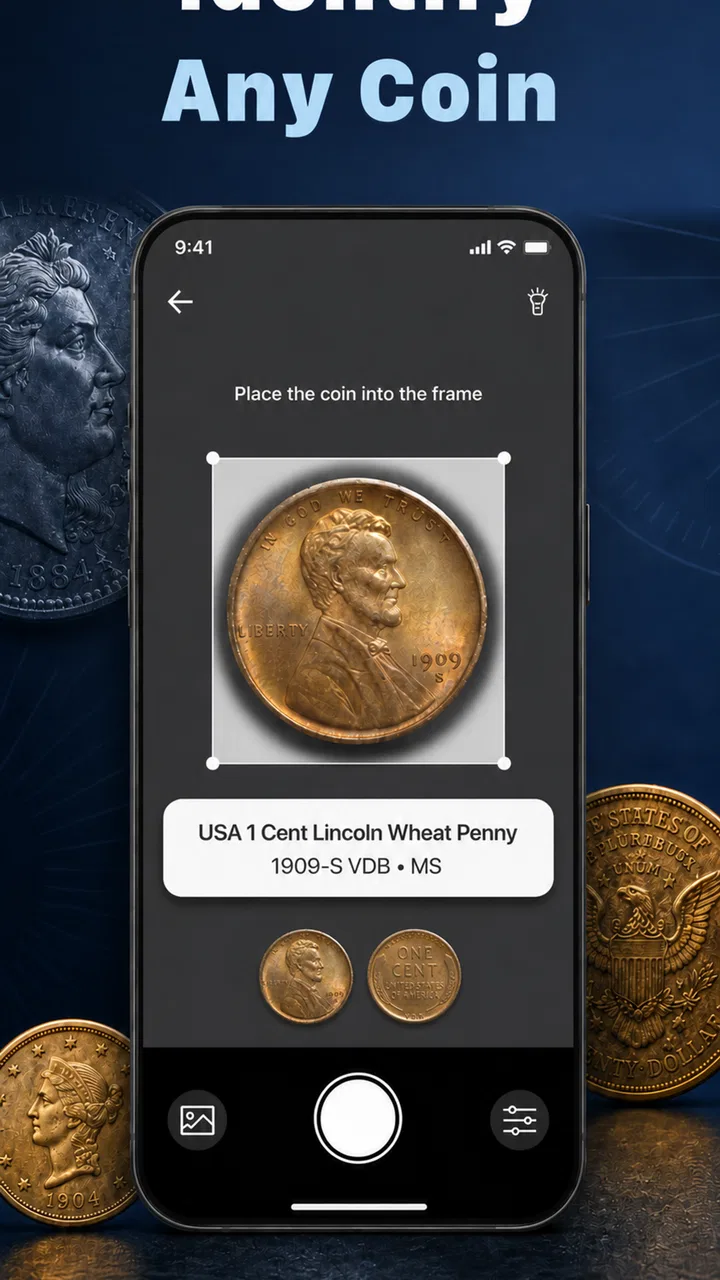
I approached HeritCoin: AI Coin Identifier as a practical tool for collectors rather than as a magic answer to every question about old money. Its purpose is easy to understand: use the phone’s camera to help identify coins and notes, estimate what they may be worth, organize a collection, and support trading decisions. In my experience, that combination makes the app most interesting when I am sorting an inherited box, checking a possible duplicate, or deciding which pieces deserve closer research.
The app comes from HeritCoin and sits in the Tools category. It is free to install, with optional in-app purchases ranging from $0.99 to $99.99 per item. That pricing matters because a free starting point makes experimentation simple, while the broad purchase range means I would look carefully at what is included before paying for anything. The age rating is Everyone, and the app supports devices running Android 8.0 or later. Its current version is 3.9.8.
How I judge the app before trusting its coin results
A coin scanner deals with more than casual curiosity. People may use it on family keepsakes, inherited collections, or items they hope to sell. That is why I would not judge HeritCoin only by how quickly it recognizes an image. I also want to know whether the app leaves room for checking the result, whether I can control what I save, and whether I can make a sensible decision without treating an automated estimate as a professional appraisal.
You May Also Like

 Blood Strike: 2.5 Anniversary
Blood Strike’s Loadouts Turn Every Drop Into a Tactical Gamble
A close look at Blood Strike’s custom loadouts: how fast access to signature weapons reshapes its battle royale rhythm, rewards preparation, and narrows the gap between fights.

 Pandora - Music & Podcasts
Pandora’s Music Is Easy to Start, but Harder to Recover
Pandora’s strength is its low-effort path from a seed to a station. Its weak spot is how much confidence it asks you to place in connection, setup, and quiet recovery.

 8 Ball Pool
 Is Built on Rivalries, Rematches, and Routine
A close look at the rivalries, rematches, shared routines, and unanswered safety questions that turn a quick pool match into a persistent mobile community.

 Samsung Music
’s Quiet Strength Is Playing What You Already Own
Its reach comes less from spectacle than from dependable access to a personal library. That simplicity is both the app’s strongest retention engine and its ceiling.

 AccuWeather: Weather Radar
AccuWeather Review: A Quick, Clear Forecast for Everyday Decisions
For everyday plans, the best forecast is the one you can understand quickly. AccuWeather makes rain timing, radar, and local conditions easy to act on, with a few trade-offs.

 Hill Climb Racing
Why Hill Climb Racing Still Turns Crashes Into One More Run
A tiny car, a bumpy hill and one more upgrade: Hill Climb Racing keeps resurfacing because its simple chaos makes every near-miss feel personal.
More From Our News Desk



The app has attracted a 4.7 average from around 63 thousand ratings, with more than 4 thousand written reviews and over 1 million installs. Those figures show that it has reached a substantial audience, but popularity is not proof that every identification is correct. Coins can look deceptively similar, and condition, mint marks, dates, material, and unusual variants can change the value dramatically.
That is the first trust lesson I took from using an AI identification tool: the result is a starting point, not a certificate. A clear scan can help narrow down what I am holding, but it should not replace a specialist when money, rarity, or authenticity is at stake. I would be especially careful with a supposedly valuable coin that is damaged, heavily worn, photographed at an angle, or covered by glare.
What the camera workflow is genuinely good at
The strongest use case is sorting. If I have a mixed group of coins, manually searching every date and design can become tedious. A camera-based workflow gives me a faster first pass, helping separate familiar pieces from items that deserve more attention. That is useful even when the final answer needs confirmation elsewhere.
I found the idea more practical for collection building than for instant selling. A collector can use a scan to create a working inventory, notice repeated items, and decide which pieces to compare side by side. The app’s cataloging purpose also makes it more useful over time than a one-off visual search that disappears after the result is displayed.
For notes, lighting and framing become even more important. I would place a banknote flat, avoid reflections, and capture enough of the design for the identifying details to remain visible. For coins, I would photograph both sides and keep the date and mint mark readable. This small habit is one of the most useful improvements a user can make: a careful image gives the recognition system a better chance than a hurried snapshot.
Why cataloging needs a deliberate routine
Cataloging sounds simple until a collection contains duplicates, inherited pieces, or coins with similar designs. My advice is to create a consistent routine from the beginning. Scan one item at a time, check the physical object against the suggested identity, and use a naming style that will still make sense months later. A catalog is only valuable if I can find the right piece again.
I would also avoid recording a value as though it were permanent. Market prices change, and an estimate may depend on condition or on details the camera cannot judge. A better habit is to treat the app’s result as a reference attached to the item, then add my own notes about visible wear, scratches, discoloration, provenance, or anything unusual. That separation between recognition and judgment is important.
One non-obvious advantage of this approach is that it reduces impulsive decisions. If I scan an inherited collection and immediately see an exciting estimate, I may be tempted to list the piece for sale. If I first record the result, inspect the coin under better light, and compare the exact variant, I am less likely to confuse a common version with a scarce one.
Controls, data-sensitive moments, and practical user choice
My cautious view is that trust should come from visible choices, not assumptions. When using a camera-based app, I pay attention to what I choose to photograph, what I decide to save, and whether I am comfortable placing personal objects into a digital catalog. A coin image is usually less sensitive than a face or a document, but a collection can still reveal financial interests, family history, or valuable possessions.
I would therefore keep the camera pointed only at the item being identified. Avoid including shipping labels, receipts, addresses, hands holding identity documents, or a background that reveals private information. This is not a criticism unique to HeritCoin; it is simply sensible behavior whenever an app analyzes images. The safest workflow is also the cleanest one: plain surface, controlled lighting, and no unrelated objects in frame.
Account controls deserve the same attention. If I decide to build a long-term catalog, I want to understand which entries are stored, how I can edit them, and how I can remove items I no longer want to keep. I would review the app’s visible settings and privacy choices before importing a large collection. If an option is unclear, I would avoid adding sensitive notes until I understood the consequence.
That caution is especially relevant for people cataloging inherited property. A collection may belong to several family members, and a private note about ownership or expected value can create unnecessary exposure if it is saved alongside an image. I would use neutral labels, keep legal or financial details outside the app, and share only the information needed for a specific trade or discussion.
Where automation can mislead a careful collector
AI recognition is helpful because it reduces search time, but it can also make an uncertain answer look more confident than it deserves. A visually similar coin may produce a plausible identification even when the year, mint mark, denomination, or country is wrong. That is why I would verify the text and symbols on the physical item before accepting the catalog entry.
Condition is another major boundary. A camera can help recognize a design, but value often depends on details such as surface marks, cleaning, wear, toning, edge damage, and authenticity. Two coins with the same basic identity may have very different market interest. I would never use a scanner estimate alone to decide whether to buy an expensive item, sell a rare-looking piece, or declare a coin genuine.
A useful three-step check is simple:
Compare the suggested identity with the date, denomination, country, and visible markings on both sides.
Inspect the edge and condition separately instead of assuming the image result includes a professional grade.
Use an independent reference or qualified specialist before making a high-value decision.
This workflow also answers a common practical question: can the app replace a collector’s reference book? For quick sorting, it may be more convenient than opening several catalogs. For final verification, a specialized reference remains better because it gives context about varieties, historical issues, mint marks, and condition. I see HeritCoin as a front door into research, not the entire library.
When the free entry point is enough, and when to pause
The free installation is a sensible way to test whether the scanning and cataloging approach fits my habits. I would begin with a small group of ordinary coins rather than a valuable collection. That lets me learn how much image preparation is needed and whether the results are useful enough for my own workflow.
Because optional purchases can range from $0.99 to $99.99 per item, I would not unlock anything simply because a scan looks promising. First I would read the purchase screen carefully and identify what the particular item provides. A paid option may be worthwhile for someone who catalogs regularly, but a casual user with a handful of coins may get enough value from the basic experience.
I would also be cautious about treating any paid feature as a guarantee of accuracy. Paying for more convenience does not automatically turn an automated identification into an appraisal. The right question is whether the purchase saves meaningful time or improves organization, not whether it removes the need for human judgment.
An everyday scenario where the app makes sense
Imagine finding a small box of coins after a relative moves house. The pieces are mixed, some are foreign, and none are labeled. I would clean the work surface without polishing the coins, photograph each item clearly, and use HeritCoin to create a preliminary list. I would separate obvious duplicates, mark uncertain results, and keep anything that appears unusual in a second group.
Next, I would compare the uncertain pieces with a trusted reference and ask a specialist about the most promising examples. The app would have saved me from manually researching every ordinary item, while the final decisions would still come from inspection and verification. That is a realistic role for the tool: reducing the boring part of sorting without pretending that collecting is only an image-recognition problem.
A second use case is trading with another collector. Before discussing an exchange, I could use the catalog to check whether I already own a similar piece and to keep the conversation organized. I would still confirm the exact item in hand, since a catalog entry can be attached to the wrong coin if duplicates are not handled carefully.
Who will appreciate it, and who should skip it
I think the app is a good match for beginners who want a guided way to explore coins and notes, families sorting an inherited group, and collectors who want a quicker first pass before doing deeper research. It is also useful for anyone who enjoys learning through comparison: scan an item, inspect the result, then discover which physical details support or contradict it.
I would be less enthusiastic for a professional dealer who needs dependable grading, precise market valuation, or a complete specialist database. The same applies to someone handling potentially rare or expensive pieces. In those situations, a dedicated numismatic reference, a professional appraisal, or direct examination is the better choice.
People who dislike camera-based workflows may also find the app frustrating. The quality of the result depends heavily on the image, and taking repeated photographs can feel slower than simply typing a date into a reference guide. If I already know the country, denomination, and year, a traditional catalog may be faster and more informative.
My final view after weighing convenience against caution
HeritCoin earns its place as a practical discovery and organization tool. Its combination of AI-assisted recognition, cataloging, and collection-focused use is more helpful than a basic visual search when I want to keep track of several items. The free starting point lowers the barrier to trying it, while the broad range of optional purchases means I would make upgrades only after understanding their value.
My main reservation is not that the concept is weak; it is that users may expect certainty from a fast result. The app works best when I stay involved: photograph carefully, check both sides, verify the physical details, separate identification from valuation, and protect private information in images and notes. Those habits turn a quick scan into a responsible collecting workflow.
Overall, I would recommend it to a curious collector or anyone facing an unsorted box of coins and notes. I would not recommend relying on it alone for authentication, grading, or a major sale. Used with that boundary in mind, the app offers a convenient first step and a useful cataloging companion. Its real strength is helping me decide what deserves closer attention, not making the final decision for me.
FAQs for HeriBase: AI Coin Identifier
01What is HeritCoin and how does it work?
HeritCoin is an AI-powered app designed to identify coins from around the world. Users simply take a picture of a coin, and the app analyzes the image to provide detailed information about its origin, year, and value. It leverages a vast database and machine learning algorithms to ensure accuracy.
02Is HeritCoin available for both Android and iOS devices?
Yes, HeritCoin is available for download on both Android and iOS platforms. Users can find it on the Google Play Store for Android devices and the Apple App Store for iOS devices, ensuring a wide user base can access and enjoy the app's features.
03Does HeritCoin require an internet connection to function?
HeritCoin requires an internet connection to access its extensive database and perform AI-driven analysis. This connectivity ensures that users receive the most accurate and up-to-date information about the coins they are identifying, making it an essential feature of the app.
04Are there any subscription fees or in-app purchases in HeritCoin?
HeritCoin offers a free version with basic features, but there are in-app purchases and subscription options available. These premium options provide users with enhanced features, such as unlimited identifications, detailed historical data, and exclusive insights into rare coins.
05How accurate is the coin identification feature in HeritCoin?
The coin identification feature in HeritCoin is highly accurate, thanks to its advanced AI algorithms and comprehensive database. While the app is designed to provide reliable results, occasional errors may occur, especially with rare or highly worn coins. Users can report inaccuracies to help improve future updates.
Pros
- Accurate coin identification using AI.
- Extensive database of global coins.
- User-friendly interface and design.
- Fast scanning and processing speed.
- Offline mode for remote locations.
Cons
- Limited to coin identification only.
- Requires high-quality images for accuracy.
- Premium features require subscription.
- Occasional bugs with coin recognition.
- Limited support for rare or ancient coins.

HeriBase: AI Coin Identifier
Gallery